

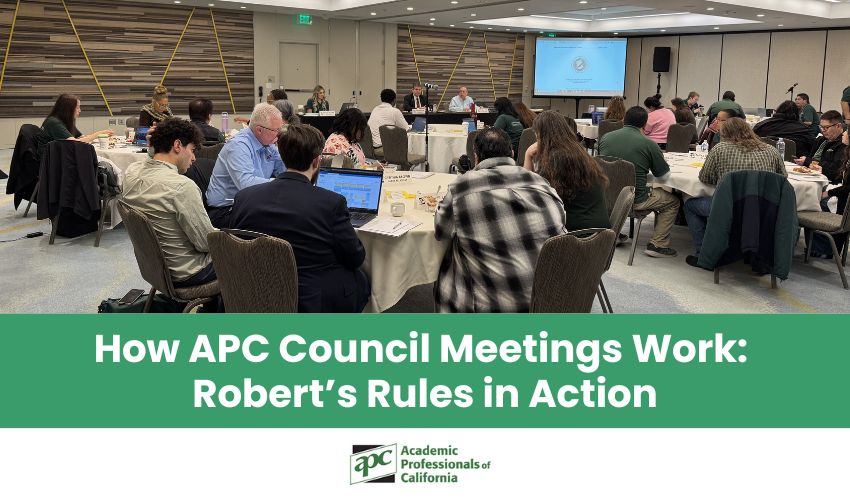
APC Council is where union business is conducted, from governance matters to decisions that shape the direction of the organization. To keep those meetings organized, fair, and productive, APC follows a structured parliamentary framework known as Robert’s Rules of Order.
With APC Council meeting again this June, it’s a good opportunity to take a simple look at how that process works.
Why APC Uses Robert’s Rules
When a group is responsible for making decisions on behalf of an organization, having a clear process matters.
Robert’s Rules of Order provides a framework that helps meetings stay focused, discussions remain productive, and decisions move forward in a structured and consistent way. Rather than relying on informal discussion alone, the process creates a shared understanding for how ideas are introduced, discussed, revised, and ultimately acted upon.
For APC Council, this helps ensure that union business is handled in an orderly way that supports fairness, transparency, and thoughtful decision-making.
What Is a Motion?
At the center of Robert’s Rules is the motion.
A motion is simply a formal proposal for discussion or action. It is the mechanism used to bring business before the group in a structured way.
For example, a motion might introduce a new idea, propose a change to an existing matter, or address an issue requiring Council discussion.
Once a motion is introduced, the group can discuss it, make adjustments if needed, and determine how to proceed.
The Four Basic Types of Motions
Robert’s Rules includes many procedural tools, but most meeting business generally falls into four basic categories.
Main Motions
Main motions are how new business is formally introduced for consideration.
This is the starting point when Council is being asked to discuss or act on a new matter.
Subsidiary Motions
Subsidiary motions affect how a main motion is handled.
These may be used to adjust language, delay consideration, or otherwise shape how a proposal moves through the discussion process.
Privileged Motions
Privileged motions address urgent matters that require immediate attention.
These typically involve procedural or time-sensitive issues that need to be handled before returning to the current discussion.
Incidental Motions
Incidental motions relate to questions about process.
These help clarify how the meeting should proceed when procedural questions arise about rules, voting, or meeting conduct.
Why This Matters
Robert’s Rules is not about making meetings unnecessarily formal.
Its purpose is to create a clear and consistent process for conducting business fairly.
Because APC Council helps shape union decisions on behalf of the membership, having a structured framework helps ensure discussions stay productive, proposals are handled consistently, and decisions move forward in an organized way.
For APC members, understanding this process offers greater visibility into how union business moves from discussion to action.
Looking Ahead to June Council
As APC Council meets again this June, Robert’s Rules will continue to provide the framework that helps meetings function effectively.
Members who have questions or concerns they would like raised can bring them to their local stewards, who help represent campus perspectives at Council. After Council meetings, stewards can also be a valuable resource for updates on discussions, decisions, and matters affecting APC members.